China Glazed Porcelain Floor
China Glazed Porcelain Floor
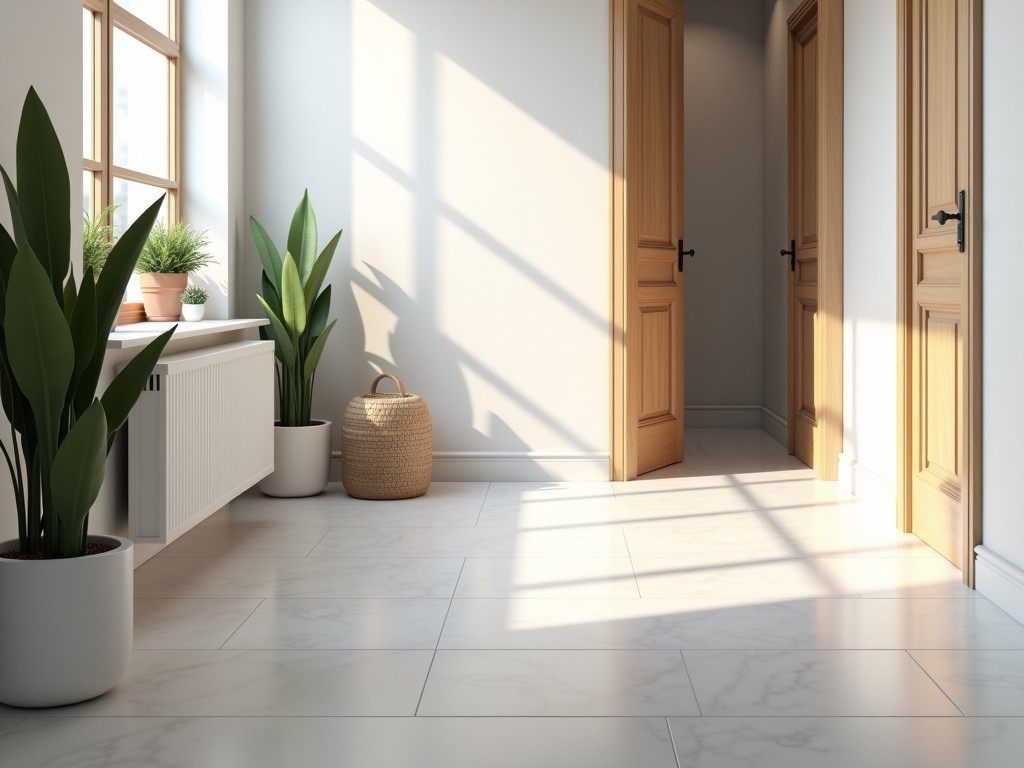
High-Performance Glazed Porcelain Floor Tiles for Industrial and Commercial Infrastructure
Selecting the appropriate flooring material for high-traffic environments requires a balance between mechanical durability, chemical resistance, and long-term stability. Unlike standard ceramic tiles, glazed porcelain is engineered through high-density vitrification, fired at temperatures exceeding 1200°C, resulting in a near-zero porosity material capable of withstanding rigorous industrial loads and environmental exposure.
Engineering Perspective: The Vitrification Process
The structural integrity of glazed porcelain is derived from its material composition and thermal cycle. The base body consists of a precise blend of clay, feldspar, and silica, which undergoes a phase transformation during the firing process. This process, known vitrification, fuses the particles into a glass-like matrix, creating a dense structure with a water absorption rate typically below 0.5%.
For procurement managers and project engineers, this low absorption translates directly to superior resistance to frost-thaw cycles and the prevention of deep-staking from oils or chemical agents. The glaze layer, applied before the final firing, is chemically bonded to the body, providing a surface barrier that is highly resistant to abrasive wear from heavy machinery movement or high-density foot traffic.
Technical Specifications and Performance Metrics
The following table outlines standard performance benchmarks for industrial-grade glazed porcelain. Specific tolerances may be adjusted based on project requirements and custom manufacturing orders.
| Parameter | Typical Value / Range |
|---|---|
| Water Absorption Rate | < 0.5% |
| PEI Rating (Abrasion Resistance) | IV - V (Heavy Commercial/Industrial) |
| Modulus of Rupture | 35 - 45 N/mm |
| Coefficient of Friction | R09 - R11 (Depending on finish) |
| Dimensional Tolerance | ± 0.5% Rectified) |
Application Scenarios in Industry
Glazed porcelain is specified in environments where material failure results in significant operational downtime. Our tiles are engineered to address specific stressors found in:
- Food Processing & Laboratories: Resistance to acidic cleaning agents and high-pressure steam sterilization protocols without surface degradation.
- Logistics & Warehousing: High load bearing capacity to withstand pallet jacks and automated guided vehicle impact impact.
- Commercial Retail Hubs: Ability to maintain aesthetic integrity under constant pedestrian abrasion and abrasive-grade cleaning equipment.
- Healthcare Facilities: Antimicrobial surface potential and ease of disinfection to maintain sterile-zone standards.
Selection Guide: Choosing the Right Finish
The choice of surface finish is a critical decision point regarding safety and maintenance. A matte glazed finish offers a higher coefficient of friction, making it suitable for areas where moisture or spills are frequent. Conversely, a polished or satin glaze provides a smoother surface for easier particulate removal, ideal for indoor commercial zones where slip resistance is less critical.
When specifying for large-scale projects, consider rectified edges. Rectified tiles are precision-cut post-firing, allowing for narrower grout lines (typically 2mm), which reduces the accumulation of dirt and enhances the visual continuity of the floor plane.
Quality Control and Logistics
To ensure supply stability across multiple project phases, every batch undergoes rigorous testing. We monitor for dimensional stability, thermal expansion coefficients, and surface hardness uniformity. For international shipments, we utilize reinforced palletized packaging with shrink-wrapped protection to prevent mechanical shock during maritime or overland transit.
Lead times are determined by order volume and specific color-to-format requirements. We provide detailed technical data sheets and material safety reports upon request to assist in the specification process.