Exporter Calacatta Look Tile High-Traffic Applications
Exporter Calacatta Look Tile High-Traffic Applications
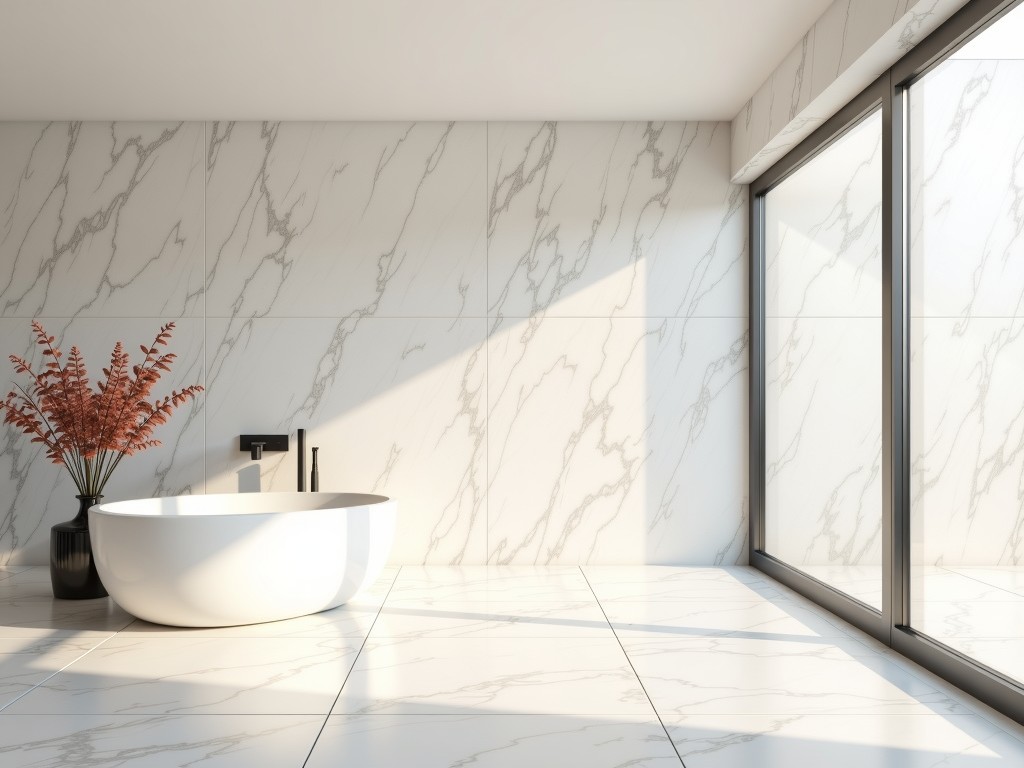
Technical Evaluation of Calacatta Look Tile for Commercial and High-Traffic Applications
Selecting Calacatta look tile for large-scale projects requires balancing the aesthetic requirements of natural marble with the rigorous performance demands of modern architectural environments. While genuine Italian Calacatta marble is prized for its distinct grey veining on white backgrounds, engineering-grade alternatives offer superior dimensional stability, near-zero porosity, and consistent resistance to chemical exposure. This guide outlines the technical specifications, manufacturing processes, and application considerations that procurement managers and design engineers must evaluate.
Material Composition and Structural Integrity
Modern Calacatta-look tiles are primarily manufactured as full-body or vitrified porcelain. Unlike traditional ceramic tiles, these materials are pressed from a mixture of refined clays, feldspar, and mineral pigments under extreme hydraulic pressure (often exceeding 4,000 tons). This compaction process results in a dense crystalline structure that eliminates air pockets, significantly increasing the mechanical strength and reducing water absorption rates.
Water Absorption: Typically
<0.5%, making="" the="" material="" impervious="" to="" freeze-thaw="" cycles="" and="" moisture="" penetration.="">Surface Hardness: Rated on PEI 4 or 5 for commercial use, ensuring resistance to heavy foot traffic abrasion.
Impact Resistance: High modulus strength prevents chipping at edges during installation or under heavy furniture loads.
Manufacturing Process: Digital Definition Printing
The visual fidelity of contemporary Calacatta patterns is achieved through high-definition digital inkjet printing technology. Unlike older screen-printing methods that produced repetitive patterns, digital printing allows for thousands of unique faces per production run. This mimics the natural variation found in stone, which is critical for lobbies or corridors where repeating veining patterns would indicate a lower-quality material to discerning clients.
Following printing, the tiles undergo a high-temperature firing process at approximately 1,200°C. This thermal treatment fuses the pigments into the glaze layer, ensuring that the "look" does not fade under UV exposure or wear away from industrial cleaning agents.
Technical Specifications Comparison
| Property | Porcelain Calacatta Look | Natural Calacatta Marble |
|---|---|---|
| Porosity | <0.5%> | 2-5% (Porous) |
| Chemical Resistance | High (Acid resistant) | Low (Susceptible to etching) |
| Maintenance | Low (No sealing required) | High (Requires periodic sealing) |
| Dimensional Consistency | High (Rectified edges) | Variable (Natural variance) |
Application Scenarios and Engineering Considerations
In commercial environments, the choice of finish is as vital as the material itself. For high-traffic transition zones, a matte or satin finish is often specified to provide a higher Coefficient of Friction (CoF), mitigating slip risks. In luxury hospitality settings or retail backrooms, a polished finish is utilized to maximize light reflectivity and visual depth, though it requires more rigorous maintenance to prevent visible scratching.
Hospitality Lobbies: Large-format slabs (600x1200mm or larger) minimize grout lines, reducing cleaning labor and enhancing visual continuity.
Commercial Kitchens: High resistance to organic acids and stains ensures the surface remains compliant with hygiene standards.
Healthcare Facilities: The non-porous surface allows for aggressive disinfection protocols without degrading the material-unlike natural stone.
Quality Control and Logistics
To ensure project-wide color consistency, our production process includes rigorous rectification. This process involves grinding the edges of the tile to achieve precise dimensions, typically within a tolerance of ±0.5mm. This precision allows for narrow grout joints (1.5-2mm), which are essential for achieving the seamless marble look characteristic of Calacatta stone.
For international shipments, tiles are palletized using heat-treated wood crates with corner reinforcement to prevent mechanical fracture during transit. Each batch is inspected for shade variation and surface defects to ensure they meet project-specific specifications before dispatch.
Request Technical Specifications or Samples
Our engineering team can provide detailed data sheets, load-bearing calculations, and material samples for your specific project requirements.
Discuss Your Project Requirements