Factory Direct Glass Pool Mosaic
Factory Direct Glass Pool Mosaic
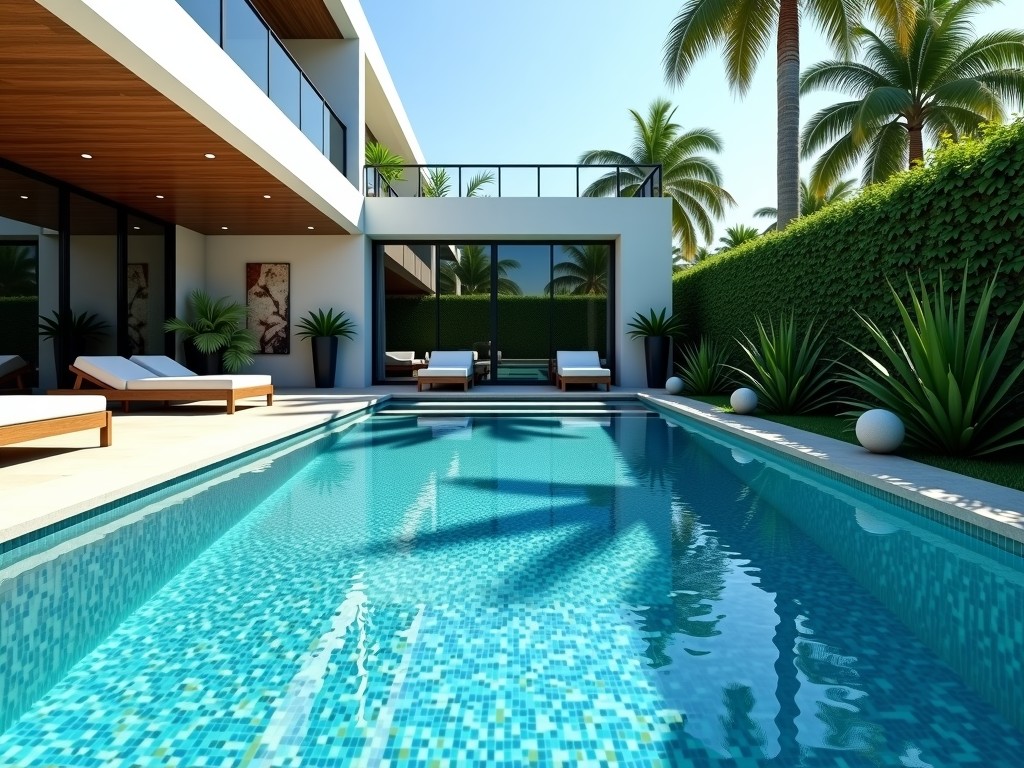
High-Performance Glass Pool Mosaic for Commercial and Residential Aquatic Infrastructure
Technical glass mosaic systems engineered for aquatic environments where chemical resistance, structural stability, and optical clarity are critical. Unlike traditional ceramic alternatives, tempered glass tiles offer a non-porous surface that prevents mineral buildup and ensures long-term dimensional integrity in large-scale pool installations.
Engineering Considerations for Aquatic Surfaces
Selecting a cladding material for pools requires an understanding of thermal expansion, UV degradation, and chemical leaching. Standard interior building tiles often suffer from micro-cracking which leads to efflorescence and structural weakening over time. Our glass mosaic solutions mitigate this through a high-density glass manufacturing process, resulting in a material that is virtually impervious to chlorine, salt, and pH fluctuations.
From a structural perspective, the bond between the mosaic and the substrate is the most critical variable. We utilize alkali-resistant fiberglass mesh backings to ensure uniform tension during the curing process of the mortar, preventing the "tenting" effect often seen in lower-grade bond systems.
- Zero Porosity: Near-zero water absorption rate prevents freeze-thaw damage and biological growth colonization.
- Thermal Stability: Tempered glass withstands rapid temperature shifts between heated water and ambient air temperatures.
- Optical Consistency: Deep-pigmentation glass prevents color fading under prolonged exposure to high-intensity UV radiation.
Technical Specifications and Material Data
| Parameter | Specification / Value |
|---|---|
| Material Composition | Tempered Borosilicate Glass |
| Tile Thickness | 8mm - 10mm (Customizable) |
| Sheet Size | 300mm x 300mm (12x12 inch) |
| Backing Material | Alkali-Resistant Fiberglass Mesh |
| Water Absorption | < 0.5% |
| Chemical Resistance | High (Chlorine, Salt, Acid-Base) |
Performance Comparison: Glass vs. Ceramic Mosaic
Procurement teams often weigh the initial material cost against long-term maintenance cycles. While ceramic mosaic offers a lower upfront price point, its susceptibility to glaze crazing and porous absorption leads to higher replacement costs over a 10-year horizon.
Ceramic Mosaic
Prone to mineral scaling; grout lines can degrade over time; requires more frequent chemical abrasive cleaning to maintain clarity.
Glass Mosaic
Non-reactive surface; high light refraction enhances water aesthetics; superior structural bond in high-pressure water environments.
Application Scenarios in Aquatic Architecture
The versatility of the mosaic format allows for application in complex geometric forms where precision cutting is required.
- Commercial Hotel Pools: High-traffic areas requiring durable, easy-to-sanitize surfaces.
- Spa and Wellness Centers: Environments with high chemical concentrations and frequent thermal cycling demand material stability.
- Luxury Residential Infinity Edge: Custom color palettes where visual depth and light refraction are primary design priorities.
- Public Fountains and Water Features: Vertical installations where adhesive weight and bond-strength are paramount.
OEM Service and Project Customization Capabilities
For large-scale infrastructure projects, we provide comprehensive customization options to meet specific architectural specifications. This includes custom color matching (RAL/Pantone), varying tile thicknesses for specific substrate depths, and specialized mesh backing for reinforced corners.
Our production facility manages dimensional consistency across large batches, ensuring that grout lines remain uniform across multi-square meter installations. We coordinate directly with design engineers to provide technical data sheets and load-bearing calculations where necessary.
Request Technical Specifications & Quotation