For Sale Extra Large Porcelain Outdoor Tiles
For Sale Extra Large Porcelain Outdoor Tiles
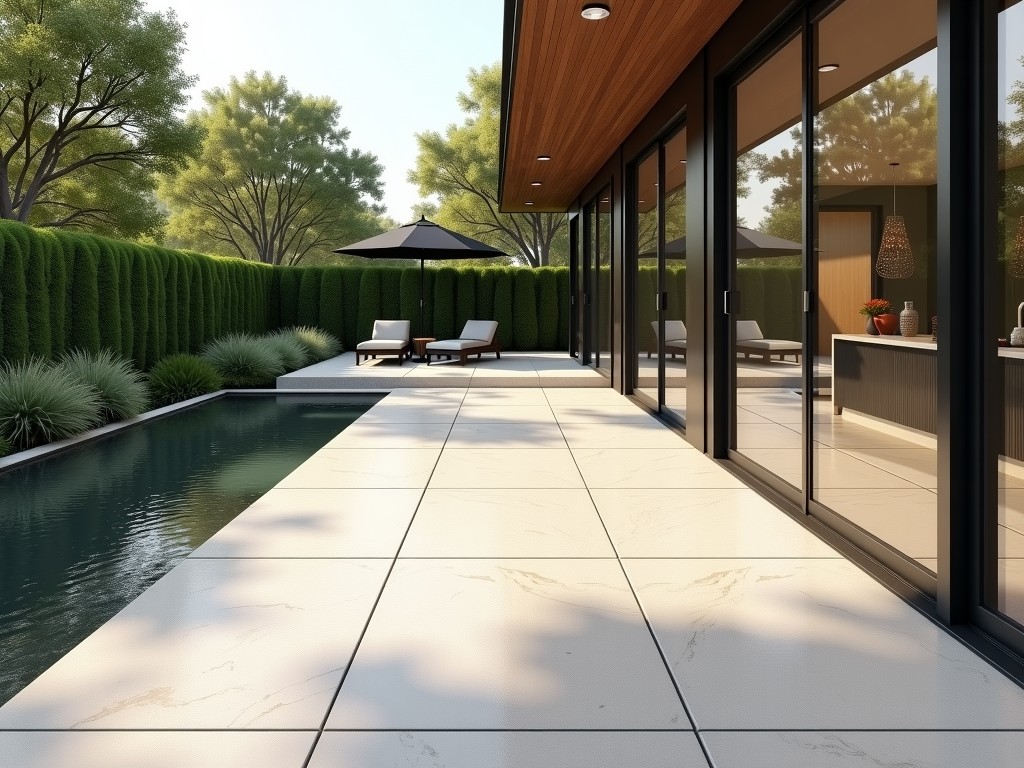
Large-Format Porcelain Outdoor Tiles for High-Performance Architectural Applications
In modern landscape architecture and commercial construction, the transition toward large-format porcelain is driven by both aesthetic demands and structural performance. Extra large porcelain outdoor tiles—typically defined by dimensions exceeding 600mm on any side—are engineered to minimize joint lines, thereby reducing water ingress points and enhancing the structural integrity of expansive surfaces. Unlike standard masonry, these tiles are manufactured through high-pressure pressing and extreme-temperature sintering, resulting in a material capable of withstanding significant thermal cycling and mechanical loads in exterior environments.
Engineering Considerations and Material Density
The performance of outdoor-grade porcelain is fundamentally rooted in its mineral composition and density. High-density porcelain stoneware achieves a water absorption rate of less than 0.5%. This characteristic is critical for outdoor applications in frost-prone climates, where moisture entering pores would expand and lead to spalling or cracking. The manufacturing process involves micronizing raw clays, feldspar, and silica, which are then compacted to create a vitrified matrix that is almost entirely resistant to UV degradation and chemical exposure.
Technical Performance Benchmarks
- Water Absorption: < 0.5% (Frost resistant rated)
- PEI Rating: Typically Class 4 or 5 for high-traffic commercial pedestrian and light vehicular zones
- Coefficient of Friction: R11 to R12 for slip resistance in wet conditions
- Modulus of Rupture: > 35 MPa, ensuring resistance to point loads
- Thermal Expansion Coefficient: Low coefficient to prevent dimensional shifting in direct sunlight
Dimensional Stability and Installation Logic
Specifying large-format tiles requires a precise understanding of substrate flatness and tolerance. As the surface area increases, the margin for error during installation decreases. Our large-format slabs utilize rectified edges to ensure dimensional accuracy within tolerances of ±0.5mm, allowing for narrow grout joints. For outdoor installations, the thin-set method using high-performance polymer mortar is mandatory to ensure full bond coverage, preventing voids that could lead to cracking under mechanical stress or thermal expansion.
| Specification | Standard Range | Engineering Benefit |
|---|---|---|
| Available Sizes (mm) | 800x160 to 1600x3200 | Reduces visual clutter and minimizes maintenance joints |
| Thickness (mm) | 6mm to 20mm | 20mm variants are optimized for pedestal-supported systems |
| Surface Finish | Matte, Lappato, Textured | Tailored for slip resistance and aesthetic requirements |
| Load Resistance | Class A (Heavy Duty) | Suitable for commercial plazas and roof terraces |
Application Scenarios in Modern Infrastructure
The versatility of large-format porcelain makes it applicable across diverse demanding environments. In rooftop terrace projects, 20mm thick slabs are often utilized on raised pedestal systems, allowing for efficient drainage and easy access to utilities below. For commercial pool decks and hotel facades, the large-format tiles provide a seamless stone-like appearance without the maintenance overhead associated with natural stone, which is prone to acid etching and staining.
Beyond aesthetics, procurement teams often evaluate the material based on life-cycle cost. Because the surface is inert and resistant to salts, oils, and cleaning agents, the frequency for deep cleaning or replacement is significantly lower compared to treated wood or natural pavers.
Logistics and Quality Assurance
Maintaining the structural integrity of large-format tiles during transit requires specialized packaging. These slabs are packed in reinforced treated wooden crates with internal foam supports to prevent deflection and fracture during shipment. Our quality control protocol includes ultrasonic testing to detect internal voids and laser-guided flatness checks to ensure that every batch meets the project's specific geometric requirements.
Technical Consultation and Quotation
For project-specific specifications, load bearing calculations, or custom dimension inquiries, please contact our engineering support team.
Request Technical Data Sheets & PricingFrequently Asked Questions
Can large-format porcelain be used on heated outdoor floors?
Yes, the high thermal conductivity and low absorption make porcelain ideal for radiant floor heating systems, provided the correct adhesive is rated for thermal expansion-contraction cycles.
What is the minimum joint width required for rectified tiles?
For rectified edges, a minimum joint of 2mm to 3mm is recommended to allow for natural thermal expansion while maintaining a seamless aesthetic.