Manufacturer High-Performance Porcelain Tiles for Industrial
Manufacturer High-Performance Porcelain Tiles for Industrial
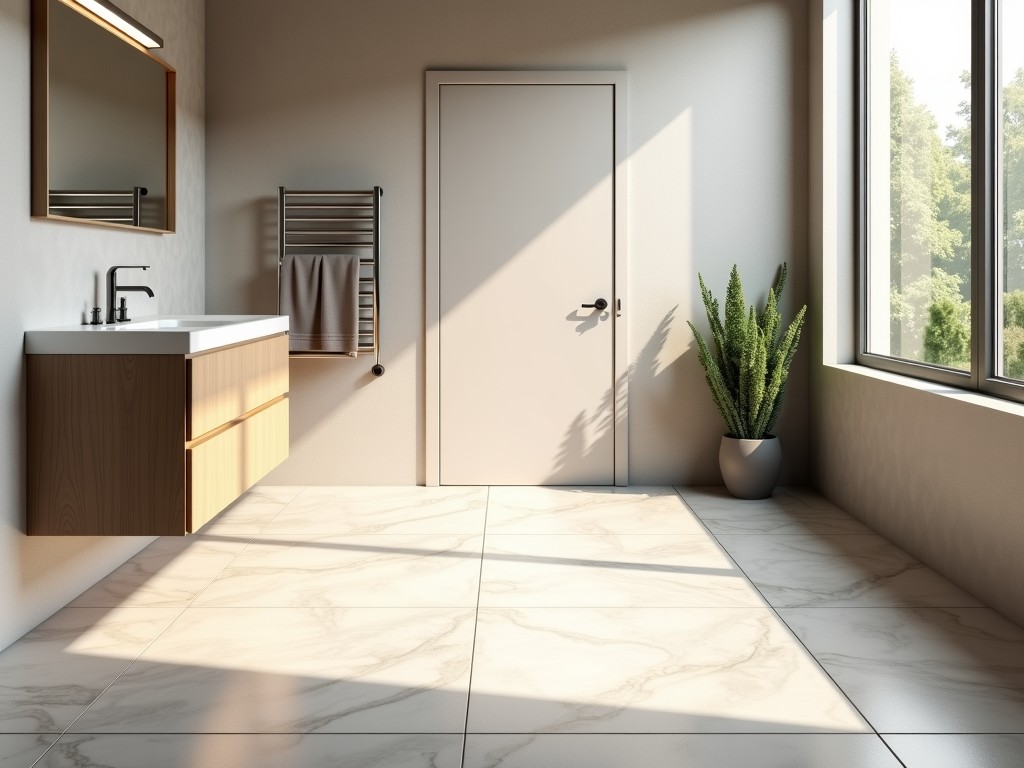
High-Performance Porcelain Tiles for Industrial and Commercial Infrastructure
In demanding industrial environments and high-traffic commercial spaces, the selection of flooring material directly impacts long-term maintenance costs and operational safety. Project porcelain tiles are engineered through a rigorous vitrification process, utilizing a mixture of natural clay, sand, and feldspar fired at temperatures exceeding 1200°C. This results in a material with near-zero porosity, making it fundamentally superior to standard ceramic in terms of moisture resistance, chemical stability, and mechanical stability.
Engineering Integrity and Material Composition
The structural integrity of porcelain tiles lies in their dense, uniform body composition. Unlike traditional tiles that rely on a thin surface glaze for aesthetics and some protection, porcelain is homogenous throughout the thickness. This means that even if the surface sustains minor abrasive wear, the aesthetic and structural properties remain intact. For procurement managers and engineers, this translates to a longer lifecycle and a reduced need for frequent replacements in heavy machinery zones or transit corridors.
From a manufacturing perspective, the high-pressure pressing stage prior to kiln firing ensures maximum density. This process eliminates internal air pockets, resulting in high dimensional stability—a critical factor for large-format installations where tight grout lines are required to prevent hydraulic uplift and ensure a level surface.
Technical Performance Specifications
The following table outlines the typical performance metrics for industrial-grade porcelain tiles. Values may vary based on specific project requirements and surface treatment selections.
| Parameter | Typical Value / Range | Industrial Significance |
|---|---|---|
| Water Absorption Rate | < 0.5% | Resistance to frost thaws and chemical penetration. |
| PEI Rating (Abrasion) | Class 4–5 | Durability against heavy foot traffic and equipment wheels. |
| Modulus of Rupture | > 35 N/mm | Structural load capacity and impact resistance. |
| Coefficient of Friction (COF) | R9 to R12 (Customizable) | Safety in wet or oily industrial zones. |
| Thickness Tolerance | ± 0.1 mm | Precision in alignment for large-format layouts. |
Application Scenarios and Environmental Resistance
Selecting the right porcelain requires understanding the specific environmental stressors of the installation site. We provide technical solutions tailored to diverse operational challenges:
Food Processing & Laboratories: Requires non-porous surfaces to prevent bacterial growth and withstand aggressive deep-cleaning agents. Porcelain ensures hygiene standards in sterile environments.
Logistics & Warehousing: High-PEI rated tiles withstand the impact and shear forces of pallet jacks and automated forklifts.
Commercial Retail & Hospitality: UV-resistant finishes prevent fading in high-natural light areas, maintaining aesthetic integrity over years of exposure.
Outdoor Infrastructure: Low water absorption prevents spalling caused by freeze-thaw cycles in climates with temperature fluctuations.
Quality Control and Procurement Standards
To ensure consistency across large-scale projects, our manufacturing process incorporates automated inspection systems. This includes laser-guided rectification to ensure each tile is perfectly square within tight tolerances. This is a critical factor for engineers specifying minimal grout joints to minimize moisture points and improve visual uniformity.
Logistics and packaging are handled with industrial-grade reinforcement. Tiles are palletized, shrink-wrapped, and braced to prevent mechanical fracture during transit, ensuring that the material arrives on-site ready for immediate installation without significant wastage.
Discuss Your Project Requirements
We assist technical consultants and procurement teams in selecting specifications for specific engineering challenges. Share your drawings, load sheets, or environmental requirements for a customized technical proposal.
Request Technical Specifications & Quotation