Project Outdoor Tiles B2B Supplier
Project Outdoor Tiles B2B Supplier
Engineering Specifications and Material Selection for Project Outdoor Grade Tiles
Selecting the appropriate surfacing for outdoor environments requires a shift from aesthetic preference to technical performance analysis. Unlike indoor flooring, project outdoor tiles must withstand fluctuating thermal expansion, UV-induced degradation, and mechanical stress without compromising structural integrity. For engineers and procurement teams, the focus remains on water absorption rates, slip resistance, and chemical resistance to ensure long-term durability and safety in commercial and industrial infrastructure.
Critical Performance Factors in Exterior Environments
The primary failure mechanism in outdoor installations is the freeze-thaw cycle. When moisture penetrates a porous material and freezes, the resulting expansion creates internal tensile stress, leading to spalling or delamination. To mitigate this, project-grade tiles utilize high-density porcelain or engineered stone bodies with water absorption rates typically below 0.5%. This density ensures the material remains impervious to moisture-related structural decay.
What Procurement Teams Usually Evaluate
- Coefficient of Friction (COF):** We prioritize R11 to R12 ratings to ensure safety compliance in wet or inclined-outdoor zones.
- Modulus of Rupture: Critical for high-traffic zones or areas subject to light equipment movement.
- UV Stability: Ensuring pigments and glazes do not fade under prolonged solar exposure over years.
- Thermal Expansion Coefficient: Matching the tile's movement with the substrate to prevent bond failure.
Material Composition and Manufacturing Process
The production of high-performance outdoor tiles involves a high-pressure pressing process. Raw mineral materials are compacted at pressures exceeding 400 bar, resulting in a dense matrix with minimal air voids. This is followed by vitrification at temperatures often between 1200°C and 1250°C. This thermal process transforms the material into a glass-like structure, providing exceptional hardness and resistance to acidic or alkaline cleaners.
For specific project requirements, surface finishes are engineered during the manufacturing stage. A matte or textured finish is achieved through mechanical abrasion to increase friction, while specialized anti-slip surfaces may utilize laser-etched patterns to provide micro-channels that enhance traction without compromising the architectural profile.
Technical Specification Comparison
| Property | Standard Porcelain | Project Outdoor-Grade |
|---|---|---|
| Water Absorption | < 0.1% - 0.5% | < 0.05% (Vitrified) |
| Slip Resistance | R9 - R10 | R11 - R13 |
| Frost Resistance | Standard | High (Cycle Tested) |
| PEI Rating | 30 - 40 | 40 - 55 (Heavy Duty) |
Installation Considerations for Engineering Teams
Successful outdoor installation depends heavily on the substrate preparation and adhesive bond. For large-format outdoor tiles, a thin-set method using modified polymer mortars is standard to ensure 100% coverage, which prevents air air pockets that could trap water and lead to cracking under mechanical load or thermal shock.
Expansion joints are also non-negotiable. Unlike indoor applications, outdoor projects require calculated movement joints every 3 to 5 meters, or at all perimeters, to allow the material to expand and contract naturally with temperature shifts without buckling or lifting the tiles.
Application Scenarios
Commercial Plazas & Terraces
High-volume traffic requires high PEI ratings and superior slip resistance to meet public safety standards under weather conditions.
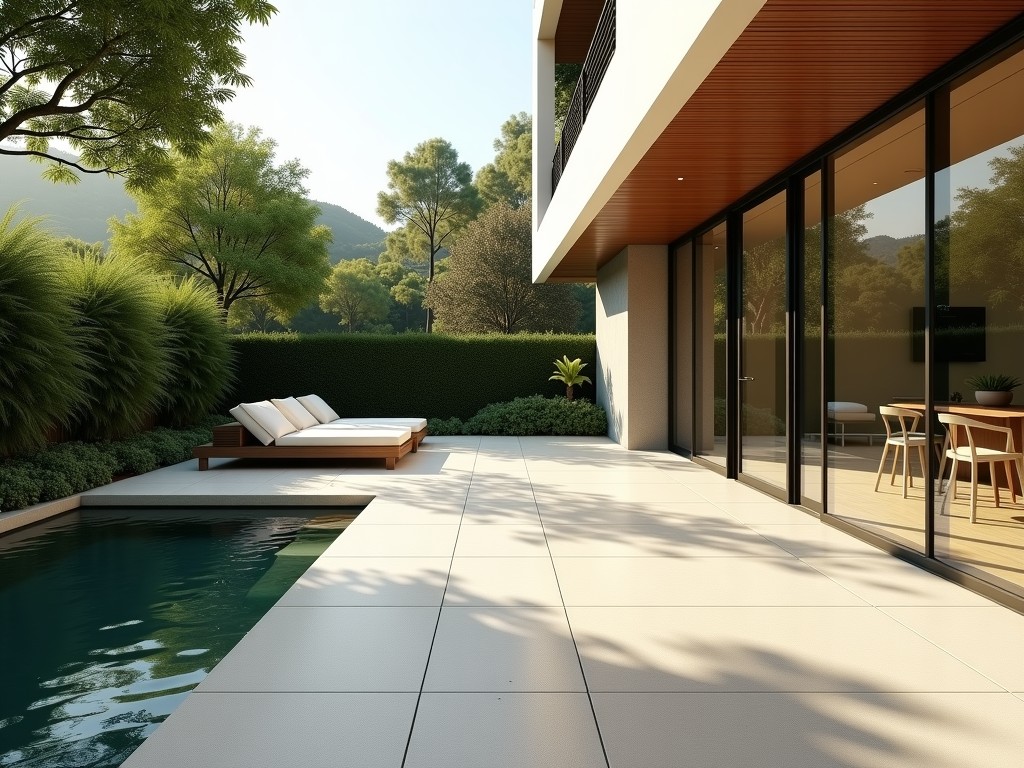
Pool Decks & Aquatic
Focus on chemical resistance to chlorine and salt, combined with high-friction textures for wet surface safety.
Industrial Walkways
Requires high load-bearing capacity and resistance to industrial oils and environmental runoff.
Frequently Asked Questions
Can these tiles be customized for specific project dimensions?
Yes, we offer custom sizing and edge-profile options to meet specific architectural plans, provided the requirements are outlined in CAD or BIM formats early in the design phase.
What is the typical lead time for bulk project orders?
Lead times vary based on stock availability and custom requirements. Generally, standard specifications are dispatched within 4-6 weeks, while customized production may require longer timelines.
Need technical data sheets or a formal quote for your next project?
Our engineering team can review your project specifications, site conditions, and material requirements for a technical consultation and proposal.
Request Technical Consultation & Quotation